Classic Crème Brûlée

Liam Reilly
| 14-05-2026
 · Food Team
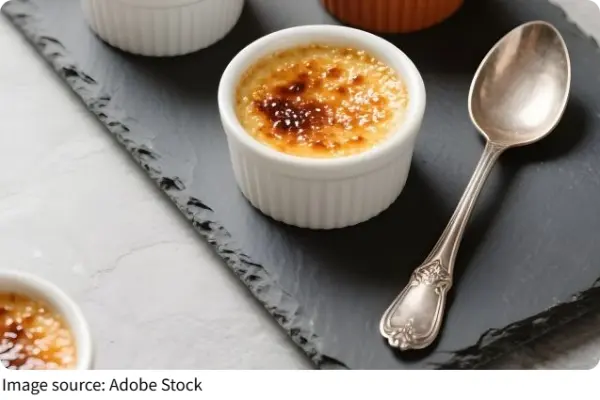
That moment when a spoon taps the caramelized sugar crust and it shatters — that's what crème brûlée is all about. The crisp top, the thin amber glass breaking away to reveal a pale, trembling custard underneath.
It looks outrageously fancy. And yet, with five basic ingredients and a little patience, it's completely doable at home.
Ingredients (Makes 4 ramekins)
2 cups (480ml) heavy whipping cream
5 large egg yolks
½ cup (100g) granulated sugar, divided
¼ teaspoon salt
1 teaspoon vanilla extract (or seeds scraped from 1 vanilla bean)
Extra granulated sugar for the brulee top
Start the Custard
Pour the heavy cream into a small saucepan. Add half the sugar (¼ cup), the salt, and the vanilla. Heat over medium heat, stirring occasionally, until the mixture just begins to simmer and the sugar dissolves. Remove from heat immediately — don't let it boil.
In a mixing bowl, whisk together the egg yolks and remaining sugar until the mixture turns slightly pale and thickened, about 1–2 minutes.
Temper Carefully
Now, slowly — really slowly — pour the warm cream into the egg yolks in a thin, steady stream, whisking constantly the entire time. This is called tempering, and it prevents the eggs from scrambling when they hit the hot liquid. Rushing this step is how you end up with sweet scrambled eggs instead of custard.
Once combined, strain the mixture through a fine mesh sieve into a pouring jug. This catches any bits that might have cooked and ensures a completely smooth, silky custard.
Bake in a Water Bath
Preheat the oven to 325°F (160°C). Arrange four 4–6 oz ramekins in a deep baking dish or roasting pan. Pour the custard mixture evenly into each ramekin.
Carefully pour hot water into the baking dish until it reaches halfway up the sides of the ramekins. The water bath surrounds the custard with gentle, even heat — it's what keeps the texture smooth and prevents cracking or curdling.
Bake for 35–45 minutes. The custard is ready when the edges look set but the center still has a slow, jelly-like jiggle when you gently nudge the pan. It will firm up further as it chills.
Carefully remove the ramekins from the water bath. Let cool to room temperature, then cover and refrigerate for at least 4 hours — overnight is ideal.
The Brulee Moment
When ready to serve, remove from the fridge and pat the surface dry with a paper towel if there's any condensation. Sprinkle 1–2 teaspoons of granulated sugar evenly over each custard. Use a kitchen torch, moving in slow circular motions, until the sugar melts, bubbles, and turns a deep, even amber.
Let the sugar harden for 30 seconds before eating. That's the crisp, glass-like top that cracks perfectly. Serve immediately — once caramelized, the sugar will start softening within an hour.
A Few Notes
Don't refrigerate after caramelizing. The sugar absorbs moisture and goes soft. Always caramelize just before serving. If you don't have a kitchen torch, the broiler works in a pinch — set the ramekins on the top rack, very close to the element, and watch carefully for 2–3 minutes. The results aren't quite as even, but they work.